 15 Sep 1998, 10:45 AM
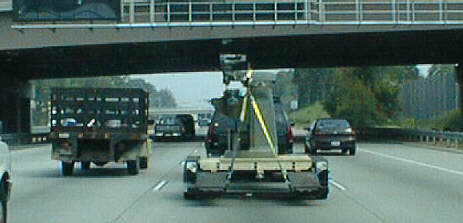
Heading out to pick up the machine with borrowed Chevy Suburban and trailer,
and my heavy wooden skid, on the Washington Beltway near Tysons Corner.
|
|
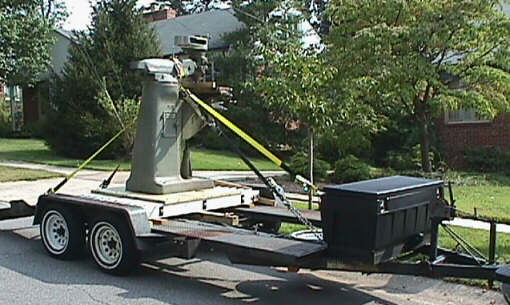
Loaded up and heading home, on Rt. 66 near Gainesville, VA. The seller used a big forklift to place the machine on the trailer. We removed the motor to lighten the head, moved the saddle towards the base, placed a 2x4 on the table, and raised the knee to firmly support the head. It took well over an hour to get it bolted down and the straps in place.
This rig won't go up hills! If you buy a Suburban and plan
to tow, I'd get the big block.
|
|
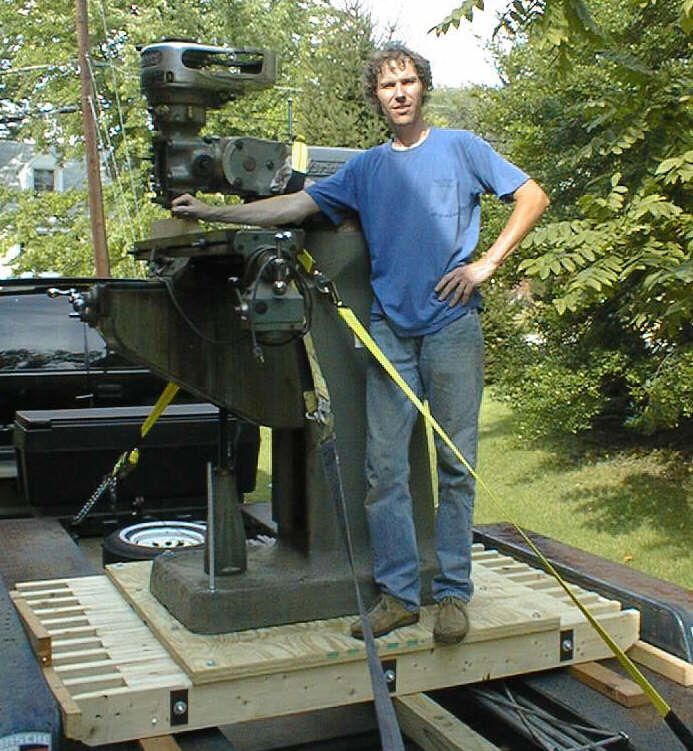
Made it home in one piece!
|
|
After 20 minutes of jockeying, the Chevy Suburban and trailer are finally backed down into the driveway.
We removed the head and called it a day.
|
|
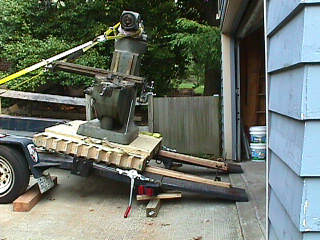
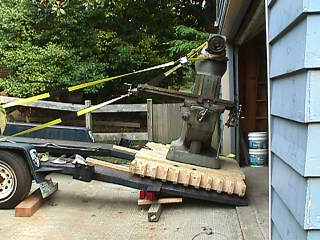
After half an hour or more of loosening straps and winching it down,
literally an inch or two at a time, the platform has moved 3 feet and
reaches the start of the ramps.
|
|
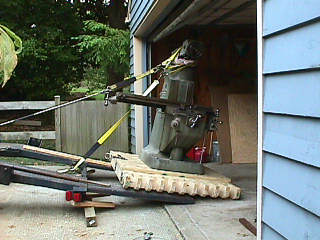
The platform now on the ramps, the upper straps run out of travel and are
extended with chains.
|
|
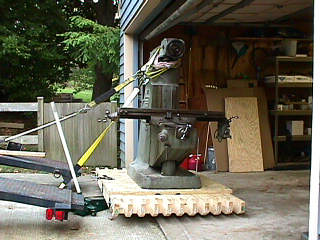
The platform reaches the bottom of the ramps.
|
|
The front edge of the platform now rests on a 1-1/2" pipe roller.
|
|
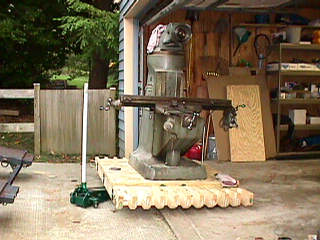
Close to the bottom, the rear edge of the platform is supported by a floor jack.
The ramps are retracted.
|
|
The upper safety straps, trailer winch cable, Come-A-Longs, and other assorted junk are removed.
The trailer is moved out of the way.
|
|
A second pipe is placed under the platform and the floor jack removed.
A few nudges with a crowbar moves it inside the garage. Call it a day.
|
|
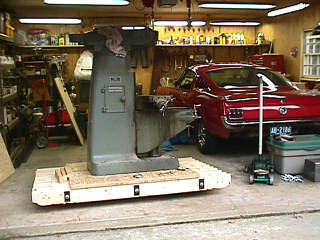
It doesn't rain all summer here in Maryland. Today it rains! The machine has been removed from the platform and disassembled down to the base to reduce the weight and awkwardness. Everything that came off the Bridgeport weighs like the dickens. The platform is disassembled and the lumber recycled for the next phase -- moving the base down four steps to the backyard.
The base is bolted down to two thicknesses of 2x6. It is set on two 8' long 4x4s, towards one end.
I raised the heavy end just off the ground with a floor jack and nudged it to the edge of the driveway.
It took about an hour to get the machine from inside the garage to the edge of the driveway.
|
|
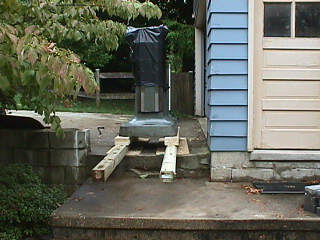
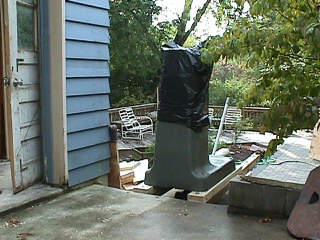
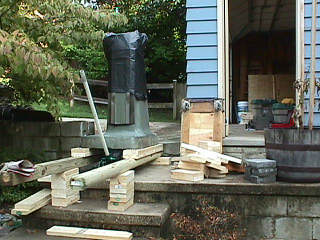
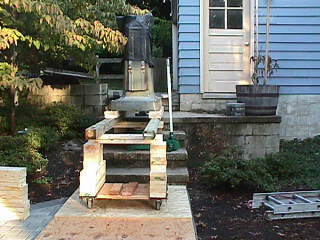
Stacks of lumber on the landing and top step are positioned to support it at the
same height as the driveway. Again the floor jack is used to lift the runners just off the ground
and it is nudged completely out over the landing. Then the blocks are removed one at a time
alternately using the jack at either end to lower everything down to the landing. These pictures show
the setup with it 3" above the landing.
|
|
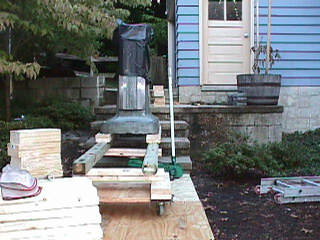
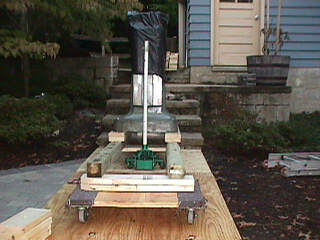
With it firmly settled on the landing, the far end of the 8' 4x4s extended out past the steps and over the brick patio below. At this point I put down two thicknesses of 3/4" plywood on the patio pavers. I didn't want to find out what would happen to those bricks trying to support the heavy load unevenly. On the new plywood road I setup a stack of blocks on a mover's dolly to support the far end of the runners.
|
|
As the runners approach the edge of the landing, wood blocks are put on the top step. Again the
floor jack it used to raise the load just off the ground as the blocks are removed one at a
time. Then some blocking is removed from the dolly end to keep everything level. It now rests
on the top step.
|
|
Getting good at it now. About ten minutes from the top step to the 2nd step.
|
|
Down the the bottom step. It's getting dark.
|
|
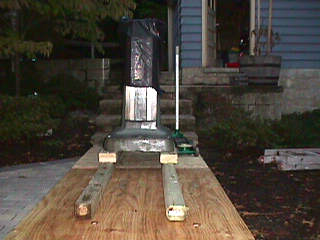
Finally, down to solid ground! Just in time to go cook dinner.
|
|
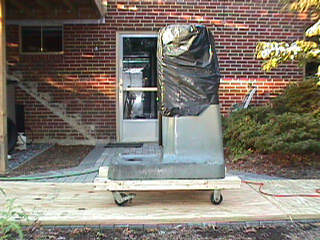
The 4x4 runners are replaced with wheels, fixed on the heavy end, casters on the other end. See that door in the background -- it's headed in there.
But first a good wash with Simple Green.
|
|
After laying down the plywood road to the back door of our walk-out basement, the base
is rolled on in.
|
|
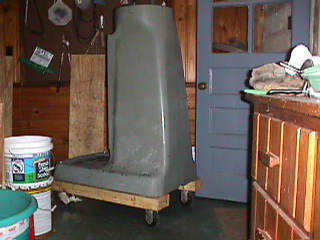
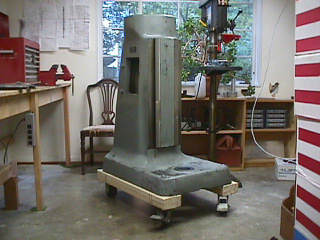
Covering carpets here and there with plywood and some grunting and the base makes it into the shop.
Countless friends and professional riggers told me I'd never get the
machine home by myself, much less into the basement.
At least not without serious injury to myself, the machine, or the house.
It's starting to look like they were wrong.
|
|
... 3 months later ...
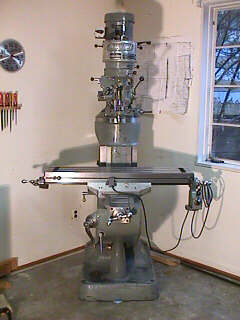
The machine was completely disassembled except for the
quill and spindle bearings. Everything was degreased,
cleaned, and shined up but no repainting was done.
After lots of work it's all back together,
lubed up and ready to go back to work.
Two sealed ball bearings in the spindle pulley
were replaced because they made noise. And I
replaced the V-belt for the hell of it.
I used the engine crane to lift the heavier pieces into position. Three times I disassembled the crane out in the garage, carried the bits into the basement, reassembled the crane, used it for 15 minutes, tear it down and carry it back outside to get the next part into a dolly. Whew! I had to leave the base up on 6 thicknesses of 2x6 so the legs of the crane would pass underneath. Lowering it back down took a bit of doing. I used a crowbar and a stack of 3/4" plywood squares. The final pieces of wood were replaced with 1" steel rounds and the machine rolled into place. I had measured and calculated the final position beforehand and marked the floor with masking tape.
During the removal of the final blocks I misjudged
the thickness of the stack under the crowbar and
found the crowbar stuck under the weight of the machine.
Just the very tip was caught, leaving perhaps a 1/8"
gap between the floor and the base. Rather than
lift it back up, replace the wood, and redo the stack
under the bar, I decided to just wiggle the crowbar
out from under the machine. So one end of it dropped, less
than a quarter of an inch. Quite a thud. My wife
came running down from upstairs. "What did you do?
The whole house shook!"
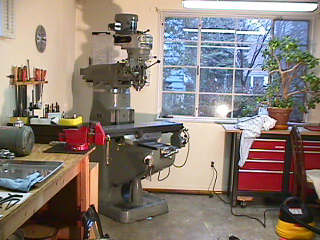
I had to reconfigure my shop to accomodate the mill.
The 16' workbench along the left wall has been cut down
to 8'. The lost space is made up with a Sears metal workbench.
The draws are a nice addition.
The mill is placed back into a corner. With
the ram all the way back there is about 2" space to
the corner. This location allows full travel of the 42" table.
A machine with a 48" table would have to sit farther out
from the wall.
|
|
|
 15 Sep 1998, 2:00 PM
 15 Sep 1998, 3:00 PM
 15 Sep 1998, 4:00 PM
 16 Sep 1998, 3:30 PM
 16 Sep 1998, 4:00 PM
 16 Sep 1998, 4:30 PM
 16 Sep 1998, 5:00 PM
 16 Sep 1998, 6:00 PM
 16 Sep 1998, 6:30 PM
 16 Sep 1998, 7:00 PM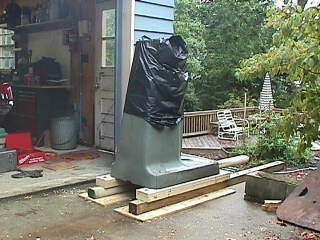
 22 Sep 1998, 5:58 PM
 22 Sep 1998, 6:21 PM
 22 Sep 1998, 6:33 PM
 22 Sep 1998, 6:53 PM
 22 Sep 1998, 7:06 PM
 23 Sep 1998, 7:06 PM
 23 Sep 1998, 7:06 PM
 24 Sep 1998, 9:00 AM
 29 Dec 1998, 1:20 PM
 Now for the 3-phase convertor...coming soon.