|
|
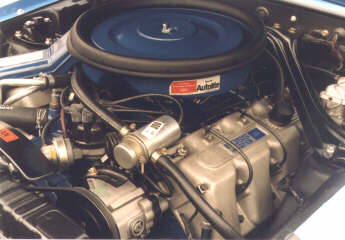
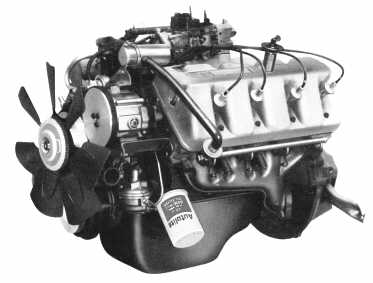
| Boss 429 Mustangs were built for one reason; to qualify the engine for NASCAR racing. Homologation rules required at least 500 cars with the Boss engine had to be sold to the public. Racing versions were fitted to Torinos for NASCAR. |
|
|
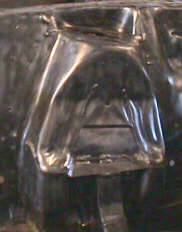
858 Mustangs were fitted with the engine in 1969, and only 499 in 1970. "Fitted" isn't the right word. The engines were shoehorned into the Mustang. The shock towers required major modification to clear the heads and exhaust manifolds. This photo shows the sculpting required as well as some reinforcing. |
|
|
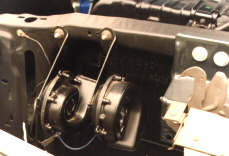
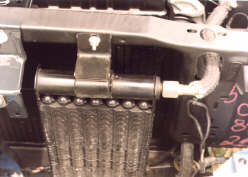
| The Boss 429 was fitted with an engine oil cooler mounted to the radiator core support on the driver's side. The horn normally found there was relocated to the passenger side. A steel reinforcing strip is found behind the core support. These features are also found on 428 Super Cobra Jet cars. | |
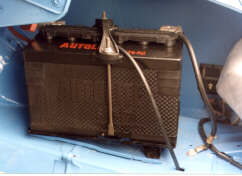
| The battery was found in the trunk. This was done for several reasons; to free up space in the engine compartment, improve weight distribution, and improve traction on the right side wheel. To keep explosive hydrogen gas and acid fumes out of the trunk special filler caps with a vent tube were used. |
|
|
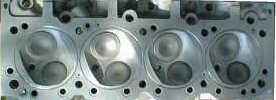
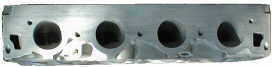
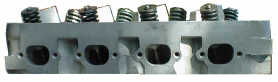
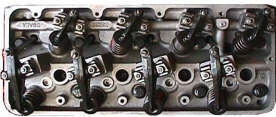
As with the 351C, the cylinder heads make the Boss 429 engine something special. The combustion chambers are a
modified hemispherical shape with small quench areas at the edges. The heads are made from aluminum alloy.
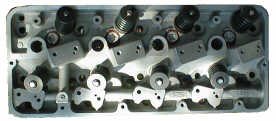
Since the pushrods pass through the cylinder heads in the normal location, one short rocker arm
and one long rocker reach the angled valves. Boss 429 engines use a dry-deck sealing scheme.
The cylinder bores are sealed by copper rings fitted to grooves. Each head also requires four 1/4"
neoprene O-rings to seal the oil passages, seventeen 1/2" O-rings to seal the water passages, and
a bead of silicone sealant. The 2.28" intake valves used on the street Boss were dwarfed by the
2.37" hollow stem monsters of the NASCAR engine.
Engine speed was electronically limited to appoximately 6100 rpm. |
|
|
|
|
|
|
|
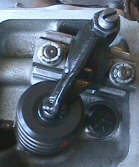
Intake rocker arm |
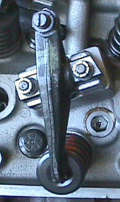
Exhaust rocker arm |
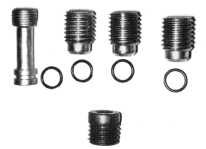
| Oil is supplied to the shaft mounted rocker arms through passages in the block and heads, rather than through the pushrods as on the normal and CJ 429. Hydraulic lifters are used on the street engine. When used in NASCAR racing, a mechanical cam is used. Oil to the tappets is restricted by switching four special O-ring sealed plugs in the oil galleries. |
|
|
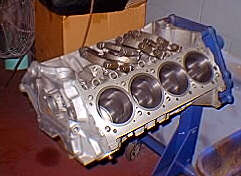
The cylinder block defers from the wedge head 429 with stronger main bearing saddles and an altered oiling system.
And of course modified to accomodate the dry-deck cylinder head sealing. 4-bolt main bearing caps are
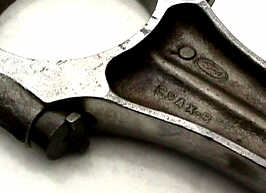
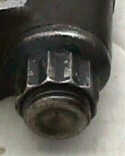
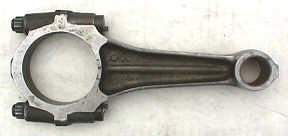
used on #1 through #4. The NASCAR connecting rods (# C9AX-B) used 1/2" bolts with 12-point aircraft style nuts.
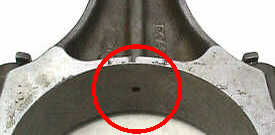
These racing rods also feature an oil passage from the big end, up through the beam, to oil the wrist pin bushing. Spray from this bushing was intended to cool the underside of the piston crowns, but instead cured another problem with the early engines, excessive wrist pin wear. This passage is not simply drilled through a normal rod. A special forging is used, with a bulge along the side of the beam to house the drilling. |
|
|
|
|
|
|
An even more wild version of this motor was built for the Can-Am racing series. The Can-Am 429 is an aluminum block monster displacing 494 cubic inches. Pistons run in dry steel sleeves. |